
Tivon™ Thermal Energy Storage System
Fuel-Independent Firm Power Infrastructure
Durable revenue stability. Long-duration asset.
Fuel-Independent Firm Power Infrastructure
Durable revenue stability. Long-duration asset.

Tivon’s Thermal Energy Storage (TES) system represents a distinct energy infrastructure asset class in which the energy inventory is effectively prepaid and embedded within the capital structure.
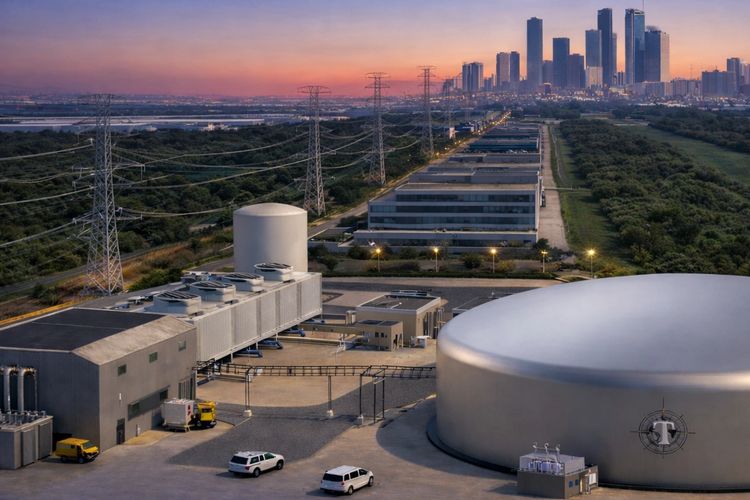
Tivon develops and deploys utility-scale thermal energy storage assets designed to deliver continuous, dispatchable power without combustion or fuel dependency.
At commercial scale, Tivon systems operate as central-station power assets, converting stored thermal energy into firm electrical output through a conventional steam-cycle architecture.
Unlike fuel-based generation, the system’s energy inventory is embedded within the capital structure, eliminating fuel procurement, fuel-price volatility, and combustion-driven overhaul cycles that are not fully eliminable through hedging.
Under long-term capacity or structured power contracts, revenue is driven primarily by availability performance and infrastructure capital recovery rather than commodity exposure.

In renewable-dominant grids, solar and wind output can swing sharply within minutes. Tivon converts that variability into steady, contractable firm capacity by decoupling variable charging input from delivered electrical output. The result is a stable power profile better aligned with grid reliability needs, long-term capacity procurement, and infrastructure-style capital recovery.
Tivon can help stabilize renewable ramp events by:
Tivon is designed to follow rapid load changes without destabilizing the thermal power block. Fast electrical controls at the facility bus manage short-duration transients while the TES and Rankine cycle respond on a seconds-to-minutes timescale through steam-side dispatch control. This control architecture enables the system to support dynamic enterprise loads while maintaining stable thermal operating conditions.
This control architecture enables Tivon to support the highly dynamic load profiles characteristic of hyperscale data centers while maintaining stable thermal operating conditions.
Tivon is architected as a dispatchable thermal-to-electric system designed to operate at stable baseload setpoints. Short-duration electrical variability is handled by fast control action and buffering at the facility bus, while the TES and Rankine block follow net load on a seconds-to-minutes timescale through steam-side dispatch control. This maintains reserve margin and prevents the steam cycle from chasing sub-second fluctuations.
Tivon’s bidirectional charge/discharge capability allows the system to absorb load reductions by redirecting surplus electrical output into TES charging as the turbine-generator ramps down. This “self-recharge during load shed” behavior converts an electrical down-step into controlled thermal recharging on a seconds-to-minutes timescale, reducing reliance on immediate grid transfer or curtailment. Recoverable performance is project-specific and should be confirmed through dynamic studies and commissioning.

Tivon delivers 24-hour firm renewable capacity through thermal energy storage, providing a capital-efficient alternative to duration-linear battery systems.
Tivon is not competing in the 4-hour storage market. Tivon is engineered for 24-hour firm capacity, where battery economics can become structurally prohibitive and deployable thermal storage can become materially more capital-efficient on an energy-duration basis.
Tivon is not a battery.
Tivon is a fuel-independent baseload power architecture.
At 24 hours, the relevant question is no longer round-trip efficiency alone. It is the capital cost of delivering firm energy at duration. That is where thermal storage can become decisive.
Tivon is structured as:
It is not structured as:
This distinction affects:
As duration increases, project economics become increasingly driven by how energy capacity scales relative to power. At 24 hours, the investment question shifts from short-duration arbitrage to firm-capacity infrastructure.
Batteries are excellent at 4 hours. Tivon is engineered for 24.
Electrochemical storage typically scales energy capacity approximately linearly with duration, while thermal storage architectures can decouple power from energy—changing how long-duration firm capacity can be provisioned. This figure is conceptual and not a representation of specific project costs.

To deliver dependable microgrids that promote environmental stewardship and community resilience, minimizing economic, social, and ecological impacts across supply chains.
To provide an innovative thermal energy storage platform that shields customers from fuel price volatility, logistics hurdles, and permitting risks—while boosting electricity security.
Tivon Energy's patented thermal storage microgrid delivers zero-emission, self-generated power from behind-the-meter sources, ensuring continuous operation without fuel dependencies.

Tivon is engineered around three mission-critical outcomes:
Legacy power requires underwriting fuel, permitting, and operating risk; Tivon is designed to eliminate those exposures through a fuel-independent, zero-emission architecture.
In Clean Air Act nonattainment regions, legacy power capacity can face tighter permitting constraints; Tivon’s zero-emission configuration is designed for improved siting optionality.
Tivon targets a 45% CAPEX and 75% parasitic load reductions versus conventional CSP-style systems. Tivon’s novel system configuration eliminates historical TES failure modes.

Collects renewable or grid electricity.
Converts it into high-temperature thermal energy inside the insulated containment vessel (ICV).
Stores heat in molten salt for long-duration retention.
Generates power via steam turbine using recovered heat.
Distribution: zero-carbon, dispatchable baseload power and optional process heat.
Electricity → Immersion Heaters → ICV (Molten Salt Storage) → Thermosyphon HX → Steam Turbine → Generator → Customer
· Fuel-independent, firm power
· Underwritable infrastructure profile
· Grid-optional microgrid operation
· Long-duration storage (not limited to 4 hours)
· Zero-emission power delivery
· Simplified system architecture vs CSP-style TES
· Peaker-displacement dispatch

A Tivon™ microgrid is designed to function as a 30-year, bond-like infrastructure asset in a market otherwise exposed to fuel-price volatility and regulatory change. By removing those exposures, the platform shifts energy infrastructure away from variable-cost operations and toward a more stable, yield-generating contracted asset profile.

The U.S. electric grid is under increasing strain from extreme weather, operational demands, cyber threats, and physical vulnerabilities—exposing mission-critical operations to significant risks.
Tivon® addresses these challenges with a utility-scale, long-duration thermal energy storage microgrid. It captures low-cost renewable electricity during surplus periods and delivers firm, reliable power on demand. Engineered for superior security and resilience, Tivon eliminates fuel supply chain dependencies and enables deployment in restrictive environments, such as Clean Air Act nonattainment areas.
Microgrids enhance power reliability by producing electricity near the point of use. Engineered for standalone (islanded) mode, they sustain essential loads amid utility grid disruptions, shielding against outages and instability. Tivon's innovative design takes this further, integrating long-duration thermal storage for fuel-independent, zero-emission resilience.

The modernization of the electric grid demands innovative solutions. Centralized electricity supply is no longer the sole reality. Transmission congestion and interconnection delays are increasingly material constraints.
Microgrids can provide transmission constraint relief by serving load locally and reducing reliance on congested transmission corridors during peak conditions. By supplying a portion of demand behind-the-meter, microgrids can also support interconnection relief, lowering incremental import requirements, easing queue pressure, and reducing exposure to transmission upgrades and curtailment risk.
Microgrids enhance reliability while delivering significant long-term savings compared to traditional utility power, mainly through reduced peak-demand charges and avoidance of premium pricing periods. Tivon advances this model by enabling fuel-independent dispatch from stored renewable energy, shielding against natural gas price fluctuations and providing consistent power under defined scenarios.
Customers can shift from volatile, fuel- and market-exposed utility energy costs to a more predictable cost structure dominated by fixed capital recovery, contracted operations & maintenance (O&M), and financing—whether via asset ownership and/or long-term service arrangements. On an illustrative benchmark basis versus a similarly sized natural gas combined cycle (NGCC) plant, a 350 MW net / 8,400 MWh Tivon configuration could avoid >$5 billion of NGCC fuel expense over 30 years, depending on site-specific dispatch, capacity factor, and the natural gas price path.
Illustrative NGCC fuel estimate assumes ~350 MW net, ~90% capacity factor, and ~6.5–7.0 MMBtu/MWh heat rate; fuel cost excludes start costs, variable O&M, and escalation.
Tivon Energy does not provide tax, legal, or accounting advice. This material is for informational purposes only, please consult your own advisors.